
Cause and Effect Play for Babies: Simple Games That Invite Discovery
Babies are tiny scientists. Drop a block, shake a rattle, press a button, and something happens. Repeating those moments is not a distraction; it is how curiosity gets practice.
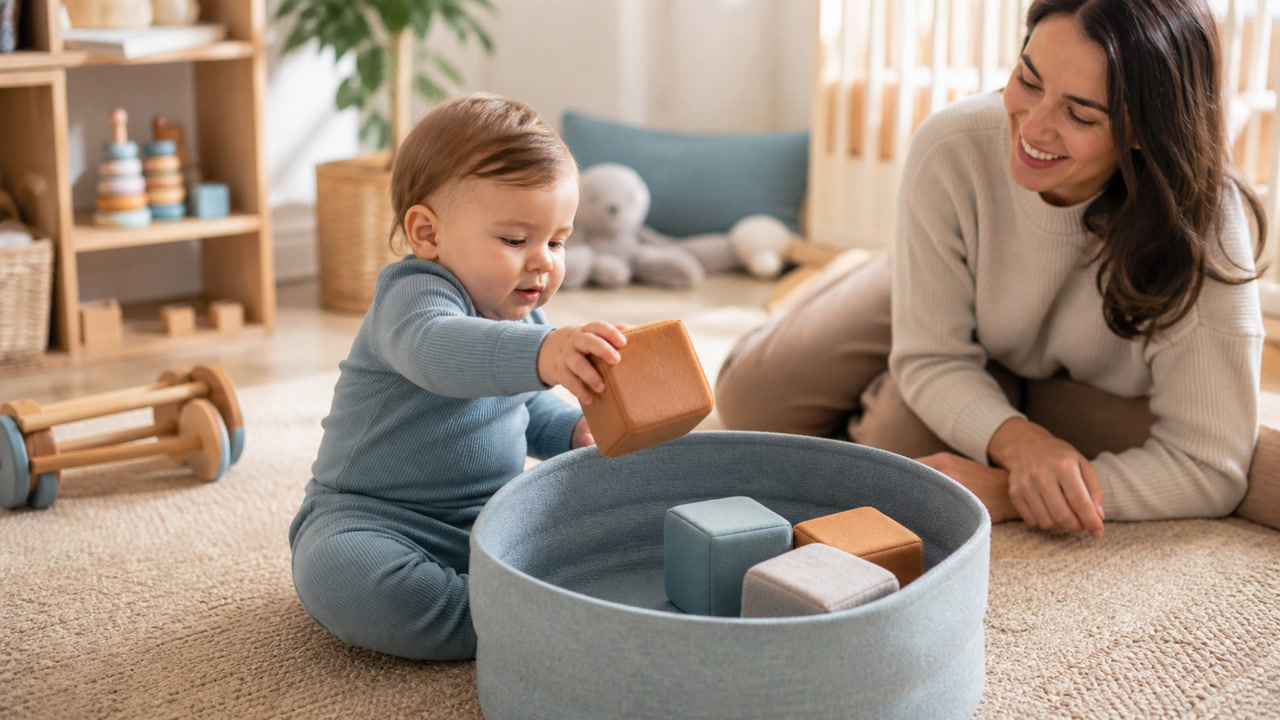
Cause and effect play helps babies notice that their actions matter. A cup falls, a sound happens; a ball rolls, it moves away; a lid opens, something is inside. Your role is not to make the result more exciting. It is to give time, safe materials, and a few words.
Choose one simple action
Offer a large ball to roll, stacking cups to knock down, a soft block to drop into a basket, or a rattle to shake. Place only a few things within reach, then wait. When your baby repeats an action, describe it: “You dropped it. It went in.”
- Use objects that are too large to be choking hazards.
- Stay nearby for all play with containers, balls, and toys.
- Let repetition continue as long as your baby is interested.
Make room for effort
It is tempting to fix a toy immediately when it rolls away or a block does not fit. Give a small pause first. That pause lets your baby look, reach, try again, or ask for help. You can then respond warmly without taking over the discovery.
These games work especially well alongside the hands-on ideas in our baby fine motor skills guide.
Follow interest, not an age chart
Some babies love dropping things for months; others prefer knocking down a tower or making a sound. Offer variations, but keep the game simple. If a toy seems frustrating, change the setup or return to it later.