
Baby Sleep Schedule by Age: What to Expect in the First Year
Understanding your baby's evolving sleep needs is one of the most impactful things you can do as a new parent. Here's your evidence-based guide to sleep patterns from birth through twelve months.
Few topics generate as much anxiety for new parents as sleep. How much should my baby be sleeping? Why do they keep waking up? When will they finally sleep through the night? These questions are universal, and the good news is that research gives us solid answers about what to expect at each stage.
Every infant is different, and the ranges below reflect averages from major pediatric studies. Your baby may sleep slightly more or less, and that's perfectly normal. What matters most is recognizing the overall trajectory and responding to your baby's individual cues.
Newborn Sleep: 0–3 Months
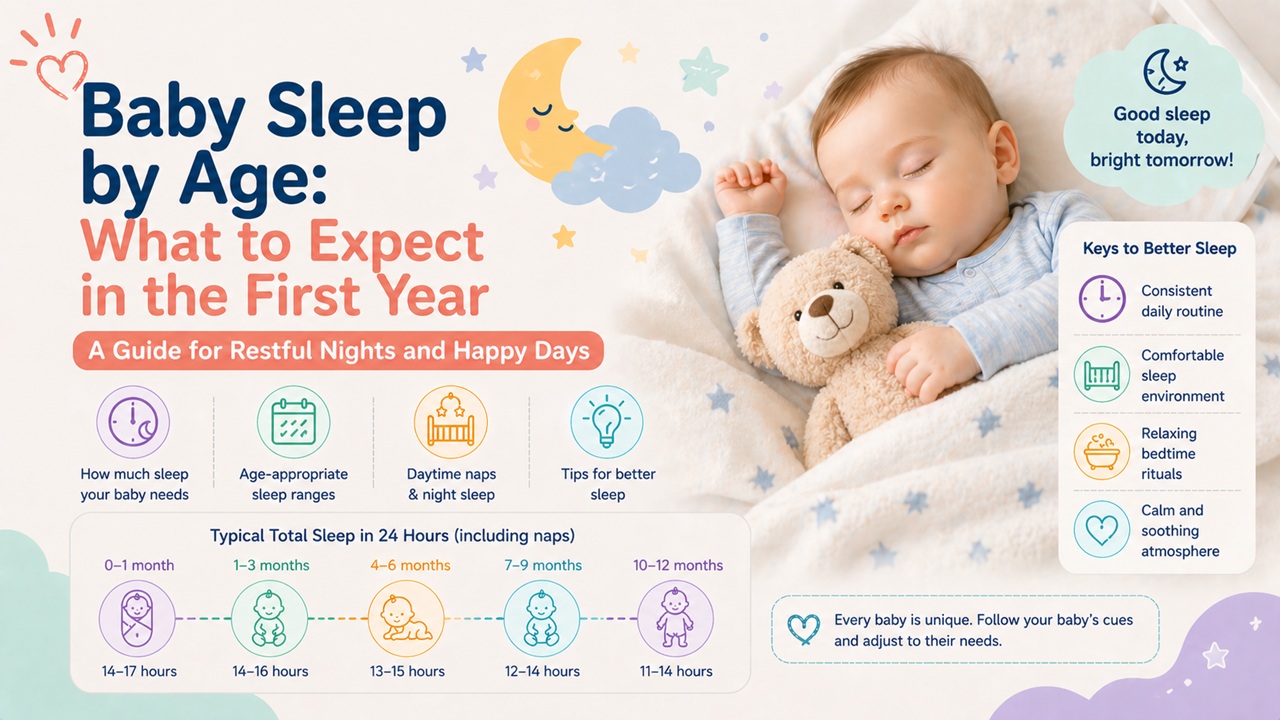
Newborns sleep a lot — typically 14 to 17 hours per day — but their sleep is fragmented into short stretches of two to four hours. This pattern exists because their tiny stomachs need frequent refueling, and their circadian rhythm (the internal clock that distinguishes day from night) hasn't developed yet.
During this period, you'll notice two types of sleep. Active sleep, characterized by fluttering eyelids and occasional twitches, makes up roughly half of a newborn's rest. Quiet sleep is deeper and more still. Both are essential for brain development.
What to expect: No predictable schedule. Frequent night wakings for feeding are biologically normal and important for growth. By the end of month three, many babies start consolidating their longest sleep stretch to four or five hours.
Safe sleep tip: Always place your baby on their back on a firm, flat surface with no loose bedding, pillows, or stuffed animals. The American Academy of Pediatrics (AAP) recommends room-sharing without bed-sharing for at least the first six months.
The 4–6 Month Shift and Sleep Regression
Around four months, babies undergo a permanent reorganization of their sleep architecture. They transition from the newborn two-stage sleep cycle to an adult-like four-stage cycle. This is the biological basis of the well-known 4-month sleep regression — and it often catches parents off guard.
Total sleep drops slightly to 12–16 hours, typically split between 10–12 hours overnight and 3–4 hours of daytime naps. Most babies take three naps at this stage: a morning nap, an early afternoon nap, and a shorter late-afternoon catnap.
The regression often manifests as increased night wakings, shorter naps, and general fussiness around bedtime. It's not a step backward — it's the brain maturing. Understanding this can reduce parental stress considerably.
Practical advice: This is a prime window to introduce a consistent bedtime routine if you haven't already. A predictable sequence — such as bath, pajamas, feeding, book, and lullaby — signals to the brain that sleep is approaching. Keep the routine under 30 minutes and perform it in a dimly lit room.
Settling In: 6–9 Months
By six months, many babies are physically capable of sleeping six to eight hours without feeding, though not all will. Total sleep averages 12–15 hours. Most infants transition from three naps to two during this window, dropping the late-afternoon catnap.
A typical schedule might look like this: wake at 6:30 AM, morning nap around 9:00 AM (1–1.5 hours), afternoon nap around 1:00 PM (1.5–2 hours), and bedtime between 6:30 and 7:30 PM. Wake windows — the time a baby can comfortably stay awake between sleeps — stretch to roughly 2.5–3 hours.
Separation anxiety often emerges around eight or nine months, which can lead to another round of sleep disruptions. Babies who previously went down easily may suddenly cry when you leave the room. This is a normal developmental milestone and typically resolves within a few weeks.
Approaching the First Birthday: 9–12 Months
From nine to twelve months, total sleep remains around 12–14 hours. Most babies settle firmly into a two-nap pattern, with naps lasting one to two hours each. Night sleep becomes more consolidated, and many babies sleep 10–12 hours overnight with zero to one feeding.
Around twelve months, some babies begin showing signs that they're ready to drop to a single nap. However, most pediatric sleep experts recommend keeping two naps until at least 14–15 months. Dropping too early often leads to overtiredness, which paradoxically causes worse nighttime sleep.
Signs of readiness for one nap: consistently fighting the morning nap, taking very long to fall asleep for either nap, or maintaining good mood and energy levels through extended wake windows of four or more hours.
Nap Transitions: A Quick Reference
Nap transitions are among the trickiest aspects of baby sleep. Here's a simplified timeline based on research from the National Sleep Foundation:
- 4–5 naps → 3 naps: Around 3–4 months. Daytime sleep organizes into clearer blocks.
- 3 naps → 2 naps: Around 6–8 months. The late-afternoon catnap disappears.
- 2 naps → 1 nap: Around 14–18 months. This transition takes the longest and may span several weeks of inconsistency.
During every transition, expect a brief regression. Bedtime may need to shift earlier temporarily to compensate for lost daytime sleep.
Establishing a Bedtime Routine That Works
Research published in the journal Sleep found that infants with a consistent nightly routine fell asleep faster, woke less during the night, and showed improved maternal mood. The exact activities matter less than the consistency. What's important is that it happens in the same order, at roughly the same time, every night.
Effective routines share a few features: they're calming (not stimulating), they happen in the sleep environment, and they end with the baby being placed in the crib drowsy but awake. Placing a baby in the crib while still slightly awake helps them learn to self-settle — a skill that pays dividends during middle-of-the-night wake-ups.
Using an app like Magerly to log bedtimes, wake times, and nap durations can reveal patterns you might miss day to day. Over a few weeks, the data often shows a natural rhythm that you can build your routine around.
Common Sleep Challenges and How to Address Them
Night wakings after 6 months: If your baby is waking frequently after six months despite adequate daytime calories, consider whether sleep associations — such as feeding, rocking, or being held to sleep — might be the cause. Babies who fall asleep under certain conditions often need those same conditions to return to sleep between cycles.
Early morning wakings: Waking before 6:00 AM is common and often caused by a bedtime that's either too late (leading to overtiredness) or too much light exposure. Blackout curtains and a slightly earlier bedtime can help.
Short naps: Naps under 45 minutes are typical for babies under five months, whose sleep cycles are shorter. After five months, short naps often indicate the baby hasn't learned to link sleep cycles. Consistent nap routines and appropriate wake windows address this over time.
Teething disruptions: Teething can temporarily affect sleep, especially with the eruption of molars. Offer appropriate pain relief recommended by your pediatrician and maintain your usual routine as much as possible to avoid creating new sleep habits that will need to be reversed later.
Safe Sleep Practices: What Every Parent Should Know
Safe sleep guidance from the AAP is clear and consistent. Babies should always be placed on their back to sleep, on a firm and flat mattress, in a crib or bassinet that meets current safety standards. The sleep surface should be free of blankets, pillows, bumpers, and toys.
Swaddling is appropriate for newborns who haven't yet started rolling, but must be discontinued at the first sign of rolling ability. Room temperature should be comfortable — around 68–72°F (20–22°C) — and babies should be dressed in sleep-appropriate clothing without overheating.
Pacifiers offered at sleep time have been associated with a reduced risk of SIDS, though the mechanism isn't fully understood. If breastfeeding, wait until nursing is well-established (typically three to four weeks) before introducing one.
Tracking Sleep Patterns with Magerly
When you're sleep-deprived, it's nearly impossible to remember when your baby fell asleep, how long they napped, or what time they woke up last night. Magerly's sleep tracking feature lets you log each sleep session with a single tap, then visualizes the data in clear daily and weekly charts.
Over time, these logs help you identify your baby's natural sleep windows, spot regressions early, and share accurate data with your pediatrician during check-ups. Many parents find that having objective data — rather than relying on foggy memory — significantly reduces the anxiety around their baby's sleep.
The Bottom Line
Baby sleep evolves rapidly during the first year. The fragmented sleep of a newborn gradually transforms into longer, more predictable stretches. Understanding the biological reasons behind each shift — from the 4-month regression to nap transitions — empowers you to respond with patience rather than panic.
Remember: sleep development, like all development, happens on a spectrum. If your baby's sleep patterns fall outside the typical ranges and you're concerned, your pediatrician is your best resource. And tracking your baby's patterns consistently with a tool like Magerly can give both you and your doctor the data you need to make informed decisions.