
When to Start Potty Training: Readiness Signs and Tips
Potty training is one of parenting's biggest milestones — for both child and parent. Knowing when your toddler is truly ready makes the difference between a smooth transition and months of frustration.
Every parent looks forward to the day diapers become a thing of the past. But potty training is one of those milestones where timing matters enormously — start too early and you'll face resistance, power struggles, and setbacks; start when your child is genuinely ready and the process often unfolds faster and more smoothly than you'd expect. The key is reading your child's unique signals rather than following an arbitrary age on the calendar.
The Typical Age Range
Most children show readiness for potty training somewhere between 18 and 36 months, with the average age falling around 27 months. However, the range is wide and normal. Some children are ready at 18 months; others aren't truly prepared until after their third birthday. Boys tend to train slightly later than girls on average, though individual variation is far greater than any gender difference.
Research from the American Academy of Pediatrics shows that children who begin training before they're developmentally ready don't finish any earlier — they simply spend more total time in the training process. Waiting for readiness signs actually leads to a shorter, less stressful experience for everyone involved.
Physical Readiness Signs
Your child's body needs to be mature enough to control bladder and bowel functions. Look for these physical indicators:
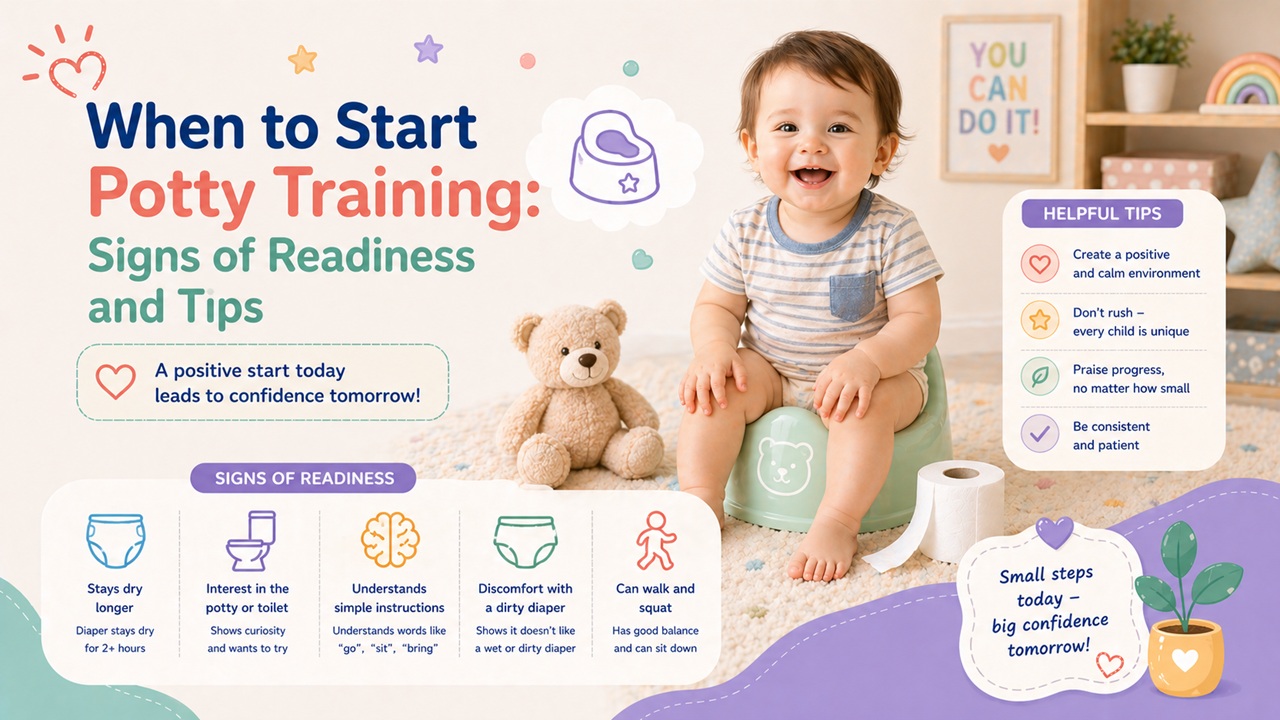
- Stays dry for 2+ hours at a time or wakes up dry from naps. This indicates their bladder has grown large enough to hold urine for meaningful periods.
- Regular, predictable bowel movements. If you can roughly predict when your child will have a bowel movement, their digestive system has established a pattern you can work with.
- Can walk to and sit on a potty independently. Basic gross motor skills are necessary for the physical act of using the toilet.
- Can pull pants up and down (with or without minor assistance). This fine motor skill is essential for bathroom independence.
- Shows awareness of the need to go — stopping play, hiding in a corner, squatting, touching their diaper, or making a particular facial expression before or during elimination.
Emotional and Cognitive Readiness Signs
Physical readiness alone isn't enough. Your child also needs the cognitive and emotional maturity to participate willingly in the process:
- Shows interest in the toilet — watching family members use the bathroom, asking questions, wanting to flush, or expressing curiosity about underwear.
- Can follow simple 2-step instructions ("Go to the bathroom and sit on the potty"). This cognitive skill is necessary for understanding the sequence of events.
- Expresses discomfort with dirty diapers — asking to be changed, pulling at a wet diaper, or saying "yucky." This shows awareness that clean feels better than wet.
- Desire for independence — "I do it myself!" A child who wants to do things independently is more likely to be motivated by the accomplishment of using the potty.
- Can communicate needs verbally or with signs. Your child needs a way to tell you they need to go — even if it's a simple word or gesture.
- Not in the middle of a major life change. New siblings, moving, starting daycare, or other disruptions make training harder. Wait for a stable period.
How to Prepare
Before officially beginning training, lay the groundwork with these preparatory steps:
- Let your child observe family members using the toilet (if you're comfortable) to normalize the process.
- Read potty-themed books together — there are excellent picture books that make the concept fun and approachable.
- Introduce the potty chair or seat adapter early. Let your child sit on it fully clothed, then with a diaper, to get comfortable with the object itself.
- Develop vocabulary. Choose consistent words for body parts and functions that your child can easily say.
- Let your child pick out underwear with characters or designs they love — this creates motivation to keep them dry.
Choosing Equipment
Standalone potty chair: These sit on the floor, are the right height for small legs, and feel less intimidating than a full-sized toilet. Many children prefer them because their feet touch the ground (important for bearing down during bowel movements) and there's no scary flushing sound. The downside: you'll need to empty and clean them regularly.
Seat adapter for regular toilet: These clip or rest on top of the existing toilet seat. They're convenient (no cleaning a separate bowl), transition directly to the real toilet, and take up less space. Pair with a sturdy step stool so your child can climb up independently and brace their feet.
Many families find having both works best — a potty chair in the main living area for quick access, and a seat adapter in the bathroom for gradual transition to the real toilet.
Step-by-Step Approach
Once you've confirmed readiness and completed preparation, here's a general framework that works for most families:
- Start with timed sits. Offer the potty at predictable times — after waking, after meals, before bath. Keep sits brief (2–5 minutes) and pressure-free.
- Celebrate successes enthusiastically. When something lands in the potty, make a big deal of it. Clapping, cheering, stickers, or a special dance all work. Positive reinforcement is far more effective than punishment for accidents.
- Transition to underwear during the day. Once your child is having regular successes on timed sits, switch from diapers to underwear during waking hours. The wet sensation motivates awareness in a way that absorbent diapers don't.
- Respond to accidents neutrally. "Oops, the pee went in your underwear. Let's get cleaned up and try the potty next time." No shaming, no frustration (at least not that you show). Accidents are learning opportunities, not failures.
- Gradually extend independence. Move from parent-initiated reminders to asking "Do you need to go?" to your child self-initiating trips to the bathroom.
Common Methods
The 3-day method: An intensive approach where you dedicate a long weekend entirely to potty training — bare-bottomed at home, constant monitoring, immediate celebration of successes. Works well for children who are highly ready and respond to intensive focus, but can be stressful for families who find the pressure overwhelming.
Child-led approach: Follow your child's pace entirely. Introduce the potty, model its use, offer opportunities, but let your child decide when they're ready to use it consistently. Less stressful but may take longer. Works well for strong-willed children who resist being told what to do.
Gradual/scheduled approach: Build potty sits into the daily routine at consistent times, slowly increasing frequency as your child gains confidence. A middle-ground option that provides structure without intensity.
Handling Accidents Positively
Accidents will happen — they're a normal, expected part of the learning process, not a sign of failure. Children who are punished or shamed for accidents often develop anxiety that actually slows progress. Stay calm, clean up matter-of-factly, and redirect to the potty. Most children have consistent daytime dryness within 3–6 months of beginning training, with occasional accidents continuing for some time after.
Nighttime Training
Nighttime dryness is a separate developmental milestone from daytime training and is largely governed by biology (specifically, the production of anti-diuretic hormone during sleep). Many children who are fully daytime trained still need nighttime pull-ups for months or even years. This is completely normal — approximately 15% of 5-year-olds and 5% of 7-year-olds still wet at night. Nighttime dryness typically develops on its own without active training, usually between ages 3 and 5.
Regression: When Training Goes Backward
It's not uncommon for a fully trained child to suddenly start having frequent accidents again. Common triggers include the arrival of a new sibling, starting a new daycare or school, illness, family stress, or any major life change. Regression is almost always temporary. Respond with patience, briefly return to a more supported approach (more reminders, timed sits), address the underlying stressor if possible, and avoid expressing disappointment. Most regressions resolve within a few weeks.
Tracking This Milestone with Magerly
Potty training is one of parenting's most celebrated milestones, and Magerly helps you document and navigate the journey. Track readiness signs as they appear, log training start dates, and celebrate the achievement when your child graduates to underwear. The app's developmental timeline shows how potty training fits into the broader picture of your child's growth — alongside walking, talking, and all the other milestones you've been tracking since birth.
Magerly's age-appropriate milestone guides also help you recognize when readiness signs are emerging, so you can prepare your approach before your child is ready to begin — ensuring a smoother, less reactive start to the process.
Trust Your Child's Timeline
In a world of competitive parenting, it's tempting to measure your child's progress against others. But potty training readiness has nothing to do with intelligence or parenting quality — it's a function of neurological maturation, bladder capacity, and emotional development that follows its own schedule. The child who trains at 20 months and the child who trains at 34 months both end up fully toilet-independent. Trust the process, watch for your child's unique signals, and know that when the time is right, they'll get there.