
When Do Babies Start Talking? Language Development Milestones
From that first coo to the thrilling moment they call you by name, language development is one of the most fascinating journeys of early childhood. Here's what the science says about when and how it happens.
Language is the foundation of human connection, and your baby's journey toward speech begins far earlier than most parents realize. Long before that first "mama" or "dada," your infant is absorbing the rhythms, tones, and patterns of language through every interaction you share. Understanding the stages of language development helps you know what to expect, when to celebrate, and when to seek guidance.
Pre-Verbal Communication: 0–6 Months
Babies are born communicators. In the first weeks of life, crying is their primary language — and research shows that parents quickly learn to distinguish between hunger cries, discomfort cries, and bids for attention. This isn't just wishful thinking: a 2016 study published in Current Biology confirmed that caregivers develop measurable accuracy in interpreting infant cries.
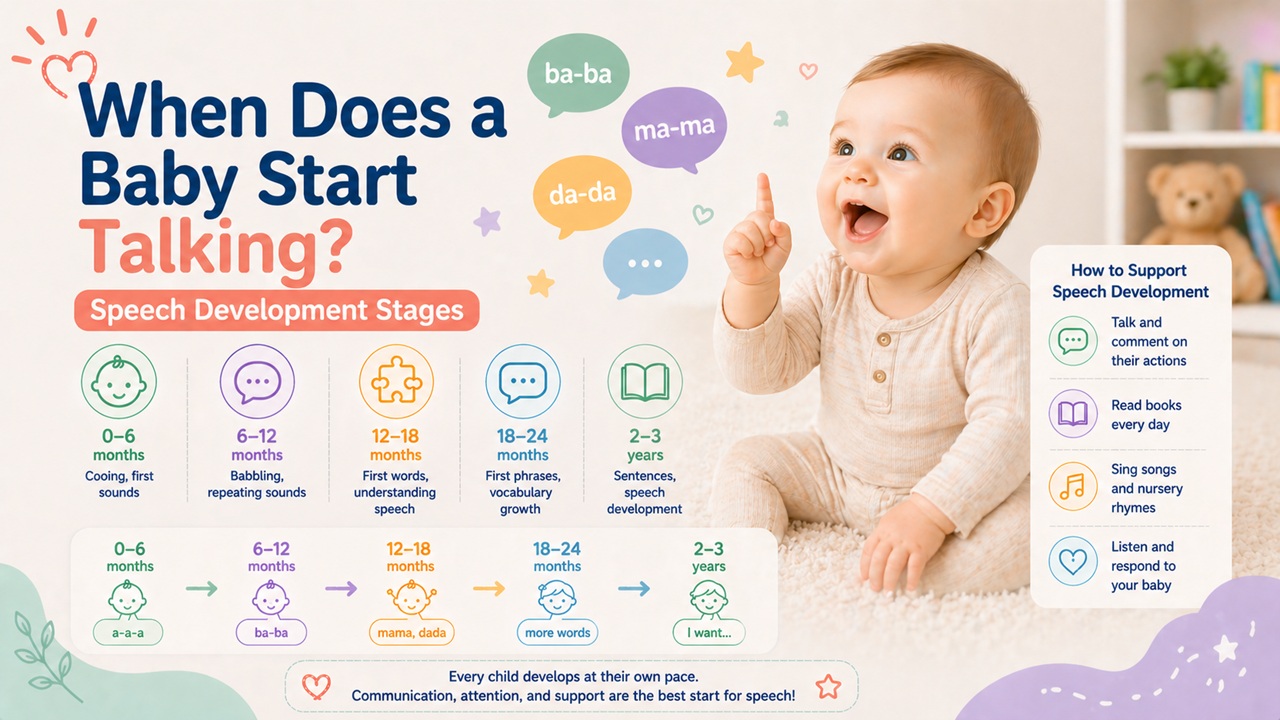
1–2 months: Cooing. Around six to eight weeks, babies begin producing soft, vowel-like sounds — "oooh," "aaah," "eee." These cooing sounds mark the first voluntary vocalizations and typically emerge during moments of contentment. Babies at this age are also fascinated by faces and will lock eye contact during conversations, even if they can't yet respond with words.
3–4 months: Vocal play. Sounds become more varied. Babies start experimenting with pitch, volume, and squeals. They may laugh out loud for the first time. Crucially, they begin to engage in "proto-conversations" — taking turns with a caregiver, pausing after a vocalization as if waiting for a response. Encouraging these back-and-forth exchanges is one of the most effective things you can do for language development.
5–6 months: Babbling begins. This is the stage where consonant-vowel combinations appear: "ba-ba," "da-da," "ma-ma." These aren't words yet — they're the brain practicing the motor patterns needed for speech. Research from the University of Washington found that babies who receive responsive feedback during babbling (parents who smile, talk back, or repeat the sounds) produce more advanced vocalizations weeks later.
First Words: 8–14 Months
The transition from babbling to meaningful words is gradual and sometimes hard to pinpoint. Most babies say their first recognizable word between 8 and 14 months, though comprehension develops well ahead of production. By 8 months, many babies understand "no," their own name, and simple phrases like "wave bye-bye."
First words tend to be labels for highly salient things in the baby's world: "mama," "dada," "ball," "dog," "more," "up." These early words are often approximate — "ba" for ball, "da" for dog — and that counts. What matters is consistent, intentional use of a sound to refer to a specific object, person, or action.
By 12 months, most babies have one to three true words in their repertoire and understand 50 or more. They point, gesture, and use body language to fill the gaps in verbal expression. Pointing, in particular, is a critical milestone: it demonstrates that the child understands shared attention and wants to communicate about the world.
The Vocabulary Explosion: 18–24 Months
Around 18 months, something remarkable happens for many toddlers: the "vocabulary explosion" or "word spurt." After months of slowly adding one or two words at a time, children suddenly begin acquiring new words at a dizzying pace — sometimes learning five to ten new words per day.
By 18 months, the average toddler uses about 50 words. By 24 months, that number jumps to 200–300 words, and many children begin combining two words into simple phrases: "more milk," "daddy go," "big truck." These two-word combinations represent a major cognitive leap — the child is now constructing basic grammar.
The range of normal is wide at this stage. Some children are chatterboxes at 18 months; others are quiet observers who suddenly unleash a torrent of words at 22 or 23 months. Both patterns can be perfectly typical.
Bilingual Development
Parents raising bilingual children often worry that exposure to two languages will cause delays. Decades of research conclusively show that this fear is unfounded. Bilingual babies hit the same language milestones at the same ages as monolingual peers, and the cognitive benefits of bilingualism — including improved executive function and mental flexibility — are well documented.
Bilingual toddlers may mix languages in a single sentence (known as code-switching), and this is a sign of linguistic sophistication, not confusion. Their total vocabulary across both languages typically matches or exceeds that of monolingual children. The key is consistent, rich exposure to both languages through meaningful interactions.
Activities That Encourage Language Development
The single most powerful driver of language development is interaction. Screens, recorded audio, and educational toys are no substitute for responsive human conversation. Here are evidence-based activities that make a measurable difference:
Talk narration. Narrate your day to your baby: "Now we're putting on your socks. These are blue socks! Let's put the left one on first." This technique, sometimes called "sportscasting," exposes babies to a rich stream of vocabulary in meaningful context.
Shared reading. Reading aloud is consistently ranked by researchers as one of the top predictors of language ability. You don't need to read every word — pointing at pictures, asking questions, and making sound effects are all valuable. Studies show that interactive reading (where the parent pauses and invites the child to participate) is more effective than simply reading straight through.
Singing and rhyming. Songs and nursery rhymes highlight the rhythmic structure of language and help babies distinguish individual sounds. The repetition in songs like "Twinkle, Twinkle" and "The Wheels on the Bus" reinforces vocabulary and builds phonological awareness — a precursor to literacy.
Responding and expanding. When your baby says "ba!" and points at a ball, respond with "Yes, that's a ball! It's a red ball. Should we roll the ball?" This technique of acknowledging and expanding validates the child's communication attempt while modeling more complex language.
Limiting screen time. The AAP recommends avoiding screen time for children under 18 months (except video calls with family). Research consistently shows that passive screen exposure does not support language acquisition and may reduce the quantity of parent-child conversation.
When to Seek Help: Red Flags for Speech Delays
While there's a wide range of normal in language development, certain signs warrant a conversation with your pediatrician or a speech-language pathologist:
- By 6 months: No babbling, no response to sounds, no smiling at people.
- By 12 months: No babbling with consonant sounds, doesn't gesture (point, wave), doesn't respond to their name.
- By 18 months: Fewer than 6 words, no pointing to show things, doesn't seem to understand simple requests.
- By 24 months: Fewer than 50 words, no two-word combinations, loss of previously acquired words or skills.
Early intervention is highly effective for speech delays. The brain's plasticity during the first three years means that therapy during this window produces significantly better outcomes than waiting. If something feels off to you as a parent, trust your instinct and ask — early evaluation has no downside.
Tracking Language Milestones with Magerly
Language milestones unfold gradually, and it's easy to lose track of when your baby first cooed, babbled a consonant, or pointed at something they wanted. Magerly's milestone tracker lets you record these moments as they happen, creating a detailed timeline of your child's communication development.
This record is valuable for more than just memories. If you ever have concerns about your child's speech development, having a dated log of milestones — when babbling started, when first words appeared, how vocabulary is growing — gives your pediatrician or speech therapist concrete data to work with rather than relying on recall alone.
The Big Picture
Language development is not a race, and comparing your child to others at the playground is rarely productive. The trajectory matters more than any single data point. A child who says their first word at 14 months is not "behind" a child who said theirs at 10 months — they're simply on a different timetable within the normal range.
What you can control is the language environment you create: rich, responsive, and full of conversation. Every word you speak to your baby is a building block. Every book you read, every song you sing, every question you ask contributes to the extraordinary cognitive construction project happening in their developing brain. And with a tool like Magerly to note each new sound and word, you'll have a beautiful record of one of the most remarkable transformations in human development.