
Best Developmental Toys for Babies by Age: 0-12 Months
The right toy at the right time can spark curiosity, build strength, and support cognitive growth. Here's your age-by-age guide to choosing toys that truly make a difference in your baby's first year.
Walk into any baby store and you'll face walls of brightly colored, buzzing, flashing toys all claiming to make your child smarter. The reality? Babies don't need expensive gadgets to develop well. What they need are simple, well-designed toys that match their current developmental stage — objects that invite exploration, challenge emerging skills, and grow with them over time. Understanding what your baby is ready for at each age takes the guesswork (and the guilt) out of toy selection.
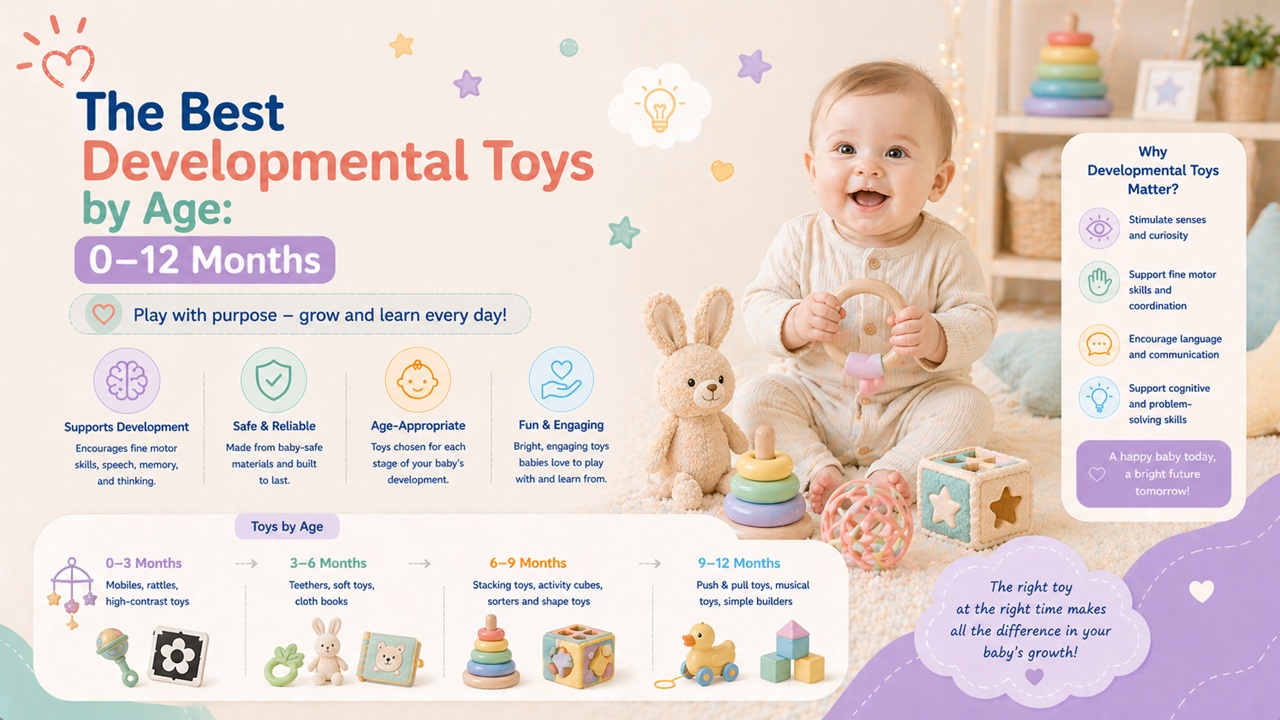
0–3 Months: The Sensory Awakening
In the first three months, your baby's world is a blur of shapes, sounds, and sensations. Their vision is limited to about 8–12 inches (roughly the distance to your face during feeding), and they're primarily focused on learning to control their eyes and hands. Toys for this stage should emphasize high contrast, gentle sounds, and simple movement.
- High-contrast cards and books: Black-and-white or bold geometric patterns are much easier for newborn eyes to focus on than pastel colors. Hold cards at face distance during alert periods.
- Mobiles: A mobile with high-contrast or primary-colored shapes hung above the crib or changing table gives your baby something to track with their eyes — an important early visual skill.
- Rattles: Lightweight rattles that make soft sounds when moved help babies begin connecting their own movement to cause and effect. Wrist rattles work well before babies can grasp reliably.
- Crinkle toys: Soft fabric toys with crinkle material inside provide auditory and tactile feedback when touched, encouraging early hand exploration.
- Play gym: An overhead play gym with dangling toys gives babies something to swipe at during tummy time and back time, building hand-eye coordination and motivating reaching.
3–6 Months: The Explorer
Between three and six months, everything goes in the mouth — and that's exactly how babies learn. They're developing their grasp, rolling over, and beginning to sit with support. Toys for this stage should be safe to mouth, easy to hold, and interesting to manipulate.
- Teething toys: Textured silicone teethers in various shapes satisfy the intense mouthing urge while soothing emerging gums. Look for BPA-free, dishwasher-safe options.
- Soft books: Fabric or crinkle books with different textures on each page introduce the concept of turning pages while providing rich sensory input.
- Play gym with reaching toys: By now, babies are intentionally batting and grasping hanging toys. Upgrade to a gym with toys that respond — bells, mirrors, spinning elements.
- Oball or textured balls: The flexible lattice design of an Oball makes it easy for small hands to grab, throw, and later roll back and forth.
- Soft stacking rings: While babies won't stack yet, they'll enjoy pulling rings off a post, mouthing them, and exploring different sizes and textures.
6–9 Months: The Experimenter
This is the age of cause and effect. Babies sit independently, reach deliberately, transfer objects between hands, and delight in making things happen. They're beginning to understand object permanence and love games of surprise.
- Stacking cups: Versatile beyond belief — stack them, nest them, fill them with water, hide small toys under them. They teach size relationships and hand-eye coordination.
- Cause-and-effect toys: Pop-up toys, buttons that play music, levers that make characters appear — anything where baby's action produces a predictable result builds cognitive connections.
- Musical instruments: Maracas, tambourines, and xylophones let babies create sound through their own actions. This supports rhythm awareness, bilateral coordination, and auditory processing.
- Peek-a-boo toys: Scarves, fabric books with flaps, or toys with doors support the developing understanding that objects continue to exist when hidden.
- Balls that roll unpredictably: Wobble balls or textured balls that bounce at odd angles encourage crawling pursuit and visual tracking.
9–12 Months: The Problem Solver
Approaching their first birthday, babies are mobile (crawling, cruising, possibly walking), increasingly dexterous, and beginning to solve simple problems. Toys should challenge their growing spatial reasoning and fine motor skills.
- Shape sorters: Matching shapes to holes builds spatial awareness, problem-solving, and fine motor precision. Start with simple versions (circle, square, triangle) before advancing to complex ones.
- Push toys: Sturdy push-along walkers or toys on wheels encourage cruising and early walking while giving babies confidence to take steps.
- Nesting and stacking blocks: Soft blocks for stacking (and the joy of knocking towers down) teach size sequencing, balance, and early planning.
- Simple puzzles: Chunky wooden puzzles with large knobs and 2–3 pieces introduce the concept of fitting shapes into designated spaces.
- Board books: By this age, babies can turn thick pages themselves and point to familiar objects when named. Interactive books with textures, mirrors, or sounds extend engagement.
What to Look for in Safe Toys
Safety should guide every toy choice in the first year. All toys should be large enough that they cannot fit entirely in your baby's mouth (the choke tube test: if it fits through a toilet paper roll, it's too small). Look for non-toxic materials, securely attached parts (no buttons, bead eyes, or ribbons that could come loose), and smooth edges without sharp seams. Always check manufacturer age recommendations, and inspect toys regularly for wear that might create new hazards.
Open-Ended vs. Electronic Toys
Research from the National Association for the Education of Young Children consistently shows that simple, open-ended toys promote more creative play, longer attention spans, and richer language development than battery-operated alternatives. A set of wooden blocks can become a tower, a road, a bridge, or a pretend phone — the child's imagination directs the play. An electronic toy that plays a song when a button is pressed offers exactly one interaction, which babies quickly tire of.
This doesn't mean all electronic toys are worthless — a simple musical instrument or a toy that responds to baby's actions can be genuinely enriching. But the bulk of a baby's toy collection should consist of items that can be used in multiple ways and grow with the child over months rather than weeks.
DIY Toy Ideas
Some of the best developmental "toys" are free household items:
- Wooden spoons and metal bowls (for banging and sound exploration)
- Empty cardboard boxes (for hiding, stacking, pushing)
- Silicone muffin tins and pom-poms (for placing in/out — fine motor practice)
- Fabric scraps of different textures (for sensory exploration)
- Plastic containers with lids (for opening/closing practice)
- A basket of safe kitchen items (whisk, measuring cups, spatula) for discovery play
Connecting Toys to Milestones with Magerly
Choosing the right toys becomes much easier when you know exactly which developmental skills your baby is working on. Magerly's milestone tracker shows you where your child is in their motor, cognitive, and social-emotional development, making it simple to select toys that match their current abilities and gently stretch them toward the next stage.
When you notice in Magerly that your baby just achieved a new milestone — like transferring objects between hands — you know it's time to introduce toys that leverage that skill, such as textured balls or stacking cups. This intentional matching of toys to emerging abilities maximizes play time and supports development naturally.
Less Is More
Research on toy quantity reveals a counterintuitive finding: children play more creatively and for longer periods when given fewer toys at once. Rather than filling a playroom with dozens of options, rotate a small selection of 4–6 toys every week or two. "New" toys from storage feel exciting without any additional cost, and the reduced visual clutter helps babies focus and engage more deeply with each object. Quality of play always trumps quantity of stuff.